Link to Article
Words: Summaya Tobah
Photos: Olena Shkoda
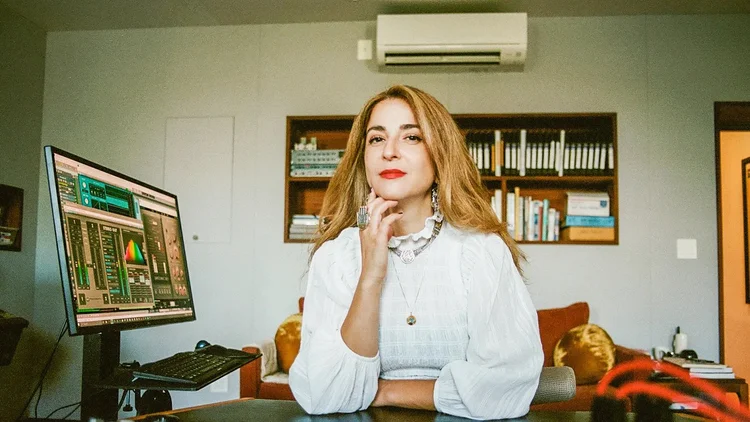
I’m chatting with Heba Kadry on an August afternoon, one month sinceChristopher Nolan’s critically acclaimed The Odyssey opened in cinemas. By the time we sit for our interview, the movie has grossed approximately $1.3 billion worldwide. Kadry worked as the mastering engineer on the film’s soundtrack. It’s exactly the kind of project that has defined her career.
A mixing and mastering artist whose credits already spanned some of the most ambitious music and film projects of the past decade, Kadry has built a lane around crafting visceral sonic experiences. Having worked on the Oscar-nominated score for the 2016 Jackie Kennedy biopic Jackie, she has now lent her ear as mastering engineer to Nolan’s epic, scored by Academy Award winner Ludwig Göransson. Being a part of the team working on a project of this scale, for Kadry, was both intimidating and exhilarating.
“Of course, [The Odyssey] was quite daunting because they’re both artists I’ve never worked with before and whom I deeply respect,” she says, referring to Nolan and Göransson. “I love these filmmakers that take chances and really try to find unusual underground artists to soundtrack their films. And those are the soundtracks I really want to work on."
Kadry’s career also spans beyond the world of cinema; her list of musical collaborators reads like your favourite playlist. Roger Waters, Björk, Sade, Gorillaz, Sufjan Stevens and Hayley Williams – just to name a few.
Talking to Kadry feels like flipping through an anthology of music history. Her understanding of sound is technical, but her relationship with it is deeply emotional. Much of what she does is intuitive, preserving the imperfections, textures and physicality that can disappear when music is reduced to ones and zeroes. Our conversation is longer than anticipated, thoughtful and nuanced. Her tone is calming and steady; an endless well of incredible knowledge that she started cultivating at an early age.
Growing up in Egypt, Kadry was surrounded by a musical culture in which listening was rarely a solitary or passive activity. When I ask her about her earliest connection to music, she references Umm Kulthum’s weekly performances, how integral and communal that time was for Egyptian culture. There was also Diwan, the Cairo bookstore and cultural institution, and its music section, which offered Kadry another portal into the world of records and artists. But more than anything, she remembers being taught how to listen.
“We’ve all been raised to have this extreme reverence for music, and specifically music that’s not just background music,” she says. “And I think that’s contradictory with how people are consuming music now. So being instilled with the idea of deep listening, that was pretty foundational.”
That deep love for music was never intended to become a career, though. Kadry graduated from the American University in Cairo and began working in advertising. “I started creating jingles and somehow I found myself at a recording studio in downtown Cairo. They had large format consoles and big monitors and I was like, ‘wow, this is something else. I want to do this’.”
Now, Kadry runs her own mastering company out of Brooklyn, New York. I ask her if she ever sees herself returning to Cairo full time. And while she doesn’t think she would ever be able to make Egypt her full time residence again, she foresees herself spending more time there – with the hopes of working on preserving Arabic and Egyptian media.
“One of my dreams is to set up audio archival conferences focused on restoring analog and digital formats,” she tells me. “The transfer and the restoration work is often delegated to engineers from the west, for the most part. A lot of the original analog tapes are completely lost altogether and impossible to track down whether due to improper storage or just lost from the archives.”
“It’s really depressing that we are left with low resolution facsimiles of some of the most important music of Egyptian popular culture,” she adds. “That’s the kind of thing that we as Egyptians need to re-examine....access to our own culture. I would love to see a way to get together with other audio restoration engineers already in the region doing the work.”
She credits already existing projects in the region like The Foundation for Arab Music Archiving & Research, and Cimatheque (specifically for films), and says she hopes to one day contribute to archiving Egyptian culture with a similar project of her own.
And yet, when asked to choose a career highlight or favorite accomplishment, Kadry says her contribution to the Le Guess Who? Music festival in 2023, just after the events of October 7th.
“It was literally a month after the seventh, and there were Palestinian artists that were on my curation that couldn't come obviously. The ugliness of the world was all coming out, and we had no idea that what was to come was even worse,” she explains. “Being able to talk to each other and hold each other's pain and grief about what we were witnessing, it was so powerful. And that was just the tip of the iceberg.”
Kadry has been outspoken in her support for Palestine and unapologetic about the intersection between art, human rights and power. She rejects the idea that artists should remain neutral – or that speaking out should come at the expense of a career.
“I don’t care if people don’t want to work with me because I care about human rights,” she says. “Then these are people I absolutely have no interest in working with. Like zero. I want them far the fu*k away from me.”
For Kadry, Palestine is not an isolated political issue. It is part of a much larger conversation about who holds power, whose lives are valued and what happens when technological and financial systems become untethered from human responsibility.
“You can draw a thread [through] the unbelievable human rights [violations] and justice in Palestine, all the way to the tech fascism and the billionaires that hold all the power,” she says.
It is a worldview that makes sense alongside her artistic philosophy. Whether she is working with an underground musician, a major filmmaker or a blockbuster film score, Kadry is interested in the human beings behind the technology – and in preserving the parts of art that cannot be automated.
That may be what makes Heba Kadry's work so compelling at this particular moment. The more the culture races toward frictionless consumption, the more valuable friction becomes. And the more she talks about sound, the more it’s clear that listening can never be passive. Maybe that is why the work of restoration matters to her as much as the work of making something new. Both endeavours ask the same questions: what’s worth keeping? And who gets to decide what gets kept?